

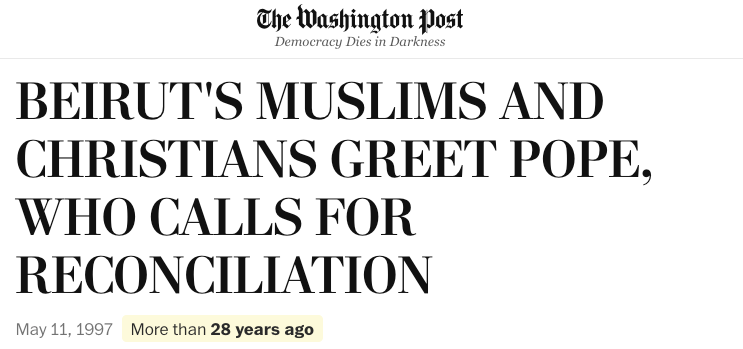
Papal visits to Lebanon have always been moments when the country pauses (briefly) to look at itself through an external moral lens. In a region where political positions are often treated as existential identities, the Pope’s presence carries symbolic weight. It forces competing factions to recalibrate how they present themselves, both internally and to the world. If you don’t believe me, read this Washington Post piece from 28 years ago. It’s as if it was written today.
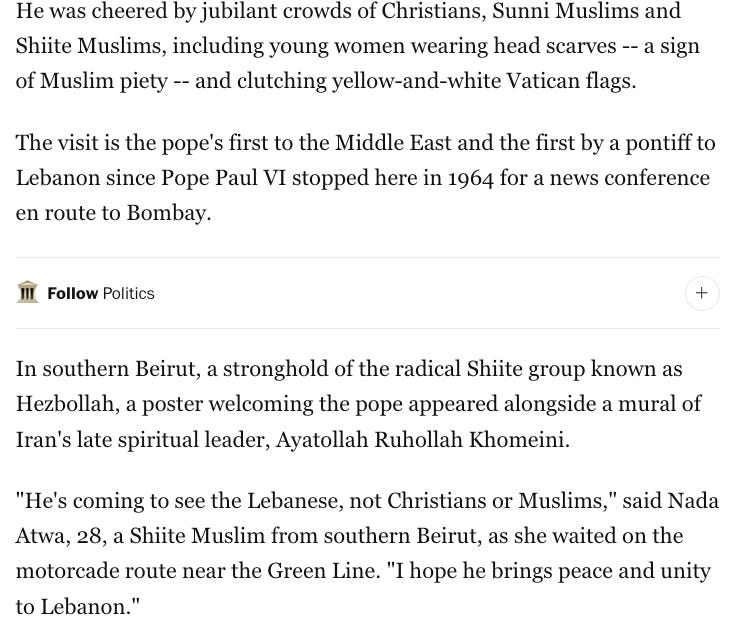
This time was no different, except instead of a civil war, it was a war Hezbollah launched, and lost, against Israel.
Israel is preparing another assault on Lebanon. That’s perhaps one of the things people were most grateful about the Pope’s visit: it would make Israel hold off from its daily bombing raids.
Hezbollah is under pressure internationally, regionally, and domestically over its military role and the growing perception that its decisions no longer reflect Lebanese consensus, as if they ever did.
Into this moment walked Pope Leo XIV. And Hezbollah tried to scramble.
The Attempt to Attach Itself to the Visit
From the moment the visit was announced, Hezbollah moved quickly to ensure it would not be symbolically sidelined. Scouts appeared in strategic locations. Party-adjacent media figures began packaging the visit as an implicit validation of “Lebanese resilience.” Influencers aligned with Hezbollah attempted to weave the event into a narrative of coexistence, national unity, and mutual respect that goes against how Hezbollah treats its own supporters, much less those it disagrees with.


The motivation was obvious: At a time when the party faces increasing isolation politically, diplomatically, and within large swathes of Lebanese society, it could not afford for the Pope’s presence to appear as anything other than inclusive of all Lebanese spheres, including its own.
But the moment, and the Pope, didn’t play along. Just like he shut down Queen Rania of Jordan’s shameful comment caught on a hot mic, trying to discourage him from visiting Lebanon.
The Pope’s Message Was Unambiguous
When Pope Leo XIV explicitly called on all armed actors, including Hezbollah, to put their weapons down and return authority to the state, it punctured the party’s attempt to appropriate the visit.
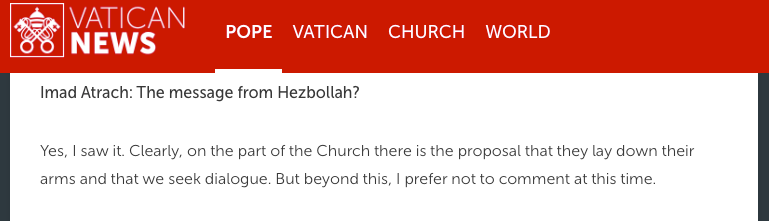
It was not framed as an attack, nor as a sectarian statement. It was framed as a simple principle: a functional country cannot have competing armies.
It is the same message repeated by every international body, every constitutional scholar in Lebanon, and every person not aligned with Hezbollah. But coming from the Pope, on Lebanese soil, during a moment of acute regional tension, it carried a moral clarity that Hezbollah could not easily absorb or ignore. It meant that they can’t stop skirting what they agreed to after losing a battle they instigated.
And so, the failed counter-narrative began almost instantly.
The Disingenuous Counterargument
Within hours, Hezbollah-affiliated influencers launched a coordinated line of reasoning: If Catholics can follow the Pope, why can’t Hezbollah follow Ali Khamenei?
Presented as a question of religious freedom, it was a textbook reframing tactic, shifting the conversation away from military decision-making and national sovereignty toward cultural and sectarian equivalence.
But the equivalence breaks down immediately.
Catholics following the Pope concerns doctrine, faith, and personal belief.
Hezbollah following Khamenei concerns decisions of war, peace, and national security, matters that directly affect the entire Lebanese population, regardless of sect, belief, or political position.
Lebanon does not pay the price of alleged Catholic obedience to the Vatican (I say alleged because remember, the Lebanese church and right wing mouthpieces still defend convicted child molester priest Mansur Labaki, even after the Vatican convicted him and defrocked him, along with the French courts).
However, Lebanon does repeatedly pay the price of Hezbollah’s military obedience to a foreign state and the Ayatollah’s wishes for better negotiating positions.
Attempting to merge the two is not only inaccurate, it is a deliberate attempt to obscure the core issue, and not even Hezbollah’s influencers take it seriously because of how disingenuous it is.
Lebanon’s Structural Reality
Lebanon’s crisis is not about religious authority or coexistence. Despite Hezbollah’s constant and aggressive attempts to reduce the entire Shia community to just Hezb, the reality is that that is not true, not by a longshot, especially after Hezbollah’s defeat and its decision to stand against the October 17, 2019 uprising that started in areas and neighborhoods Hezb claims to own.
The current crisis is about monopoly of force.
It is about whether a state can function when an armed group retains the ability to unilaterally start or end conflicts with a neighboring entity.
And it is about the democratic impossibility of a political system in which one actor is not accountable to the institutions the rest of the population must live under.
The Pope’s statement, then, was not an attack but a reiteration of a principle that any sovereign country requires: a single, unified authority over weapons and war that is democratically controlled, not with Hezb car bombs and militias ineffective against Israel, but very effective against unarmed Lebanese who don’t bend the knee.
No rhetorical pivot can change that.
Why Hezbollah’s Narrative Fell Flat
Hezbollah misread the room. Badly. It is so stuck in its past glory days, it is incapable of doing anything else.
Lebanese exhaustion has reached a level where symbolic gestures no longer land. That includes segments of society Hezb considers “theirs”. The population has lived through a collapsed banking sector, a hollowed-out state, rolling blackouts, border clashes, drone strikes, and the constant threat of escalation and none of which they chose.
So when the Pope called for disarmament, most Lebanese heard something they have long wanted themselves.
And when Hezbollah tried to reframe the visit as an issue of religious double standards, the response, across the digital public sphere, was muted at best, dismissive at worst. Their pick-me energy that was more cringe than believable.
There is a growing understanding that Lebanon can no longer carry the weight of a permanent militia structure that makes decisions on behalf of millions who did not consent to those decisions.
What the Visit Ultimately Revealed
The Pope did not shift Lebanese political dynamics. He did not broker a new consensus. He did not break Hezbollah’s entrenched position.
But his presence exposed something important: Hezbollah is increasingly sensitive to how it is perceived, increasingly isolated, and increasingly reliant on narrative management to justify its continued militarized role. I’d even say desperate.
I don’t believe carrying the Vatican flag along with a Nasrallah photo is sincere, it’s just to say, “See?! Look how tolerant we are! Now, let’s forget we agreed to disarm after we lost the war we started, and give us some slack for this performative stuff to try to bask in the coverage the Pope’s visit brings.”
In that sense, the Pope’s message landed exactly where it needed to. Not as a command. Not as a condemnation. But as a reminder.
That Lebanon cannot survive indefinitely with its sovereignty held hostage to parallel structures, not even ones that portray themselves as guardians of national dignity, when that has never been the case.
In that clarity, many Lebanese found something rare: An articulation of the obvious, delivered without fear and platitudes meant to waste time, hoping that some miracle that will never come, will help Hezbollah get back to its peak, which even they know is never gonna happen again.


